
March 23, 2026 Insights
Why Early Collaboration Delivers Better Outcomes Than Hard Bid
By John Cleveland, Director of Water Operations, Midwest Region, Shook Construction
For decades, hard bid, often delivered through Design‑Bid‑Build, has been the default for public and industrial construction projects — and for good reasons. It’s familiar. It’s defensible. It creates a clean paper trail that satisfies procurement requirements. It’s also easy to explain to boards, councils, and taxpayers. And in some cases, it’s required.
At Shook Construction, when we sit down with public owners and city officials, we’re often talking with people who have managed several successful hard‑bid construction projects. But others we talk with have lived through the other side of it. Projects where things didn’t go quite as planned because of unforeseen circumstances. Projects that received limited contractor proposals. Projects with unexpected change orders, scope creep, work stoppages, designer and general contractor disagreements, and uncomfortable public conversations.
This isn’t about portraying hard bid as “bad.” It’s about talking honestly about what we’ve seen across water, wastewater, healthcare, education, industrial, and aerospace projects and how early collaboration can lead to better outcomes when projects get complex.
Why Hard Bid Became the Default
Hard bid, or Design-Bid-Build (D-B-B), became the dominant construction delivery method because it offered a transparent and well-understood process that aligned with the needs of public agencies, non-complex projects with a clearly defined scope, and industries that valued price certainty and separation of design and construction roles.
Institutional and procedural factors
- Standardization – Over decades, D-B-B became a standardized process, making it easy for owners, designers, and contractors to understand and follow.
- Legal and contract clarity – The sequential nature of the method reduced ambiguity in contracts, which was important for projects with clearly defined scopes.
- Risk allocation – The core theory behind D-B-B is that designers were held accountable for the design and contractors for construction, creating clear lines of responsibility for owners to manage.
Hard bid works best when three conditions are true:
- The scope is well defined
- The risk is well defined and predictable
- The project is relatively simple based on repeatable processes
In those situations, competitive bidding can control upfront costs. For projects that fit that mold, D‑B‑B remains a reasonable and often effective approach.
The challenge is that many modern public and industrial projects no longer fit neatly into that box. Regulatory complexity, aging infrastructure, new technology, design aesthetics, and operational challenges all introduce variables that are difficult to fully capture on drawings that are created before a general contractor is involved. Rising inflation, combined with pricing databases that struggle to keep up with price escalations, create additional challenges for owners relying on D-B-B.
Hard bid doesn’t fall short due to a lack of effort. It becomes challenging because teams are often asked to make key scheduling, pricing, and decisions about risks later in the process.
Where Hard Bid Starts to Break Down
Risks Show Up After It’s Been Priced
In a traditional D‑B‑B process, the designer is selected to evaluate the project and complete the drawings. A general contractor then bids the project. The contractor prices the project based on the early designs and assumptions. That’s exactly how the system is supposed to work.
The problem is that many of the biggest project risks aren’t visible on bid day:
- Fewer bidders might mean owners pay a premium
- There may be a tradeoff between expertise and price
- Constructability conflicts may exist within the early design and assumptions
- Unknown site conditions
- Lack of a contingency budget leading to more change orders and cost overruns
- Scope gaps between disciplines
- Operational constraints that don’t show up clearly in drawings
When these issues surface during construction, they don’t disappear. They turn into change orders, claims, or schedule extensions — or all three.
Hard bid is designed to control the number accepted on bid day. It does little to control the total cost of the project once construction begins and challenges emerge.
Owner Time Becomes Reactive Instead of Strategic
One of the common misconceptions we hear at Shook Construction is that hard bid is designed to reduce owner involvement. In reality, it just postpones it.
When issues arise during construction, owners get pulled in later to:
- Resolve conflicts
- Make emergency decisions
- Review and approve change orders
- Justify changing costs with other stakeholders
- Schedule slippage discussions
Instead of spending time early in the project aligning goals and expectations, owners end up spending time later managing problems under pressure. The time investment is still there, but it often takes on a more reactive, urgent, and visible form.
Change Orders Become Part of the Process
Most change orders aren’t the result of bad intentions. They’re the result of timing and a lack of early collaboration to proactively address challenges.
In hard‑bid projects:
- Contractors must deal with price uncertainty due to a lack of a contingency budget
- Designers don’t benefit from early constructability feedback
- Owners don’t see the cost of decisions until after pricing is locked
By the time construction starts, the opportunity to proactively solve problems in a cost-effective way has passed.
What Early Collaboration Delivers
Early collaboration doesn’t eliminate risk; it simply changes when risk is identified and how it’s managed.
When designers, owners, and contractors collaborate from the start:
- Constructability issues are identified while they’re still in design
- Budget conversations happen before scope is finalized
- Owners gain greater cost predictability through continual estimating as design progresses
- Schedule impacts are understood before commitments are made
This shift alone dramatically reduces the likelihood of late‑stage surprises. Problems don’t go away; they are addressed earlier when the stakes are lower and when there is time to consider options.
Collaboration as a Risk‑Management Strategy
One of the biggest misconceptions about collaborative delivery is that it mainly benefits the contractor. In practice, it’s about owners distributing risk where it can be best managed.
Different collaborative delivery models offer different levels of owner involvement, risk management approaches, and control. Owners benefit from shared risk because it creates less friction and greater alignment among designers, engineers, and general contractors.
Construction Manager at Risk (CMAR): Early Insight, Risk Protection
The CMAR delivery method allows owners to retain a separate design contract while bringing in the expertise of a construction manager early on to provide preconstruction services, constructability analysis, and continuous updates of probable costs — and to establish a Guaranteed Maximum Price (GMP). CMAR is a common middle ground, especially for public owners.
What an owner gains:
- Early constructability input
- Help with pricing and budget management
- Collaboration on scheduling and pacing
- Cost certainty through a GMP
This model is especially effective for public owners who value collaboration but need to maintain design oversight and control the schedule.
What’s the Tradeoff?
While CMAR offers advantages for many owners, the greatest benefits are often realized on larger projects. Sometimes, CMAR contracts can be a bit more complicated, requiring more legal review. However, the success of a CMAR project ultimately hinges on the experience and consistent performance of the construction manager.
Progressive Design-Build: Clarity Before Commitment
Progressive Design-Build (PDB) brings the owner, designer, and builder together before the project scope and budget are fully defined. Rather than locking in budget based on early assumptions, the team works through the design progressively, validating scope, schedule, and risks. The PDB method is becoming more popular, with 58% of owners planning to use it in the coming years, according to the Design Build Institute of America (DBIA) and FMI Consulting’s “Design-Build Utilization” report.
As the design advances, cost estimates are refined in real time. This allows owners to understand the impact of decisions and alternatives while there is still flexibility to adjust. Once the design reaches an agreed-upon level of definition, the project moves to establishing to a Guaranteed Maximum Price (GMP) for construction.
What an Owner Gains:
- Early and transparent cost development as design develops
- Access to a builder’s real-time pricing database for more accurate estimating
- The ability to manage risk proactively in the planning stages
- Schedule compression where design and construction proceed in parallel
- Flexibility to address evolving challenges, such as market shifts, on longer-term projects
- Fewer disputes between designer and builder
- Greater alignment between scope, budget, and operational needs
- Elimination of late-stage change orders driven by unknowns or assumptions
PBD is particularly effective for complex projects where conditions, requirements, or priorities are evolving, and where early collaboration adds the greatest value.
What’s the Tradeoff?
PDB requires owners to select a team based on qualifications, experience, and its ability to collaborate effectively rather than basing a decision on price alone. Through the Best Value Design-Build selection process, this delivery method requires early active owner participation, as decisions made during the design process directly influence the construction budget and schedule.
Why Construction Delivery Choices Carry More Weight With Public Owners
The delivery method public owners select directly impacts the project’s ability to meet performance standards, manage risks, meet public and political accountability, and achieve cost savings. Public projects often require a balance between speed, quality, and budget making the delivery method a critical factor in the overall project outcome.
When public projects run into trouble, the impact isn’t just financial. It’s reputational.
Choosing a process that includes early collaboration helps reduce surprises, creates documentation around decisions, opens clear lines of communication, and demonstrates proactive risk management to stakeholders.
In many cases, transparency earlier in the process is easier to defend than the lowest number on bid day.
A Better Question to Ask Up Front
Instead of owners asking, “Which delivery method gives us the lowest price?” we at Shook Construction encourage owners to ask, “When do we want to discover our risk — in design or during construction?”
Early collaboration allows owners to:
- Make informed decisions sooner
- Take advantage of contractor and subcontractor expertise
- Avoid conflicts between designers, contractors, and facility directors
- Streamline the decision-making process
- Analyze pricing early to determine the impact of potential changes in relation to cost and schedule
- Improve communication throughout the process
- Spend time strategically rather than reactively
- Reduce change orders and cost overruns
The most successful projects that Shook Construction is involved with start with alignment, not assumptions. The question isn’t whether risk exists, but rather when decisions and outcomes are easier to manage. When owners are given the time to consider how and when risk should be addressed, delivery methods become strategic tools — not just procurement requirements. Early collaboration gives teams the opportunity to proactively solve problems on paper, make informed tradeoffs, and move forward with confidence, balancing transparency with accountability.
About the Author
In his role as Director of Operations, John Cleveland oversees all water and wastewater projects throughout Shook’s Midwest Region, where he focuses on client satisfaction, project oversight, and adherence to regulations, quality, and safety standards.
 Tippecanoe Middle School Construction Career Day
June 7, 2024News
Tippecanoe Middle School Construction Career Day
June 7, 2024News
 Top Considerations for Choosing a Project Delivery Method
June 5, 2024Insights
Top Considerations for Choosing a Project Delivery Method
June 5, 2024Insights
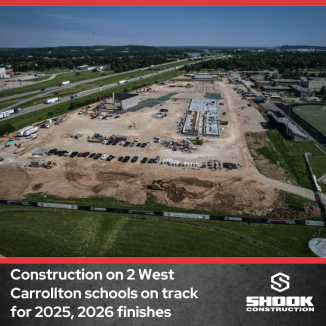 West Carrollton City Schools' New Facilities Are Taking Shape
June 4, 2024News
West Carrollton City Schools' New Facilities Are Taking Shape
June 4, 2024News
 Shook Releases Documentary About Mission Trip to Thailand
June 3, 2024Mission
Shook Releases Documentary About Mission Trip to Thailand
June 3, 2024Mission
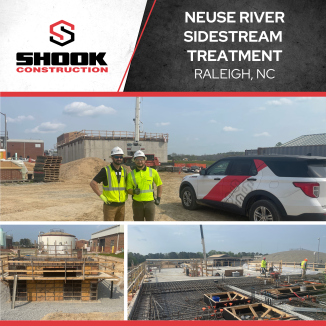 Progress Continues on the Neuse River Sidestream Treatment Project
May 31, 2024News
Progress Continues on the Neuse River Sidestream Treatment Project
May 31, 2024News
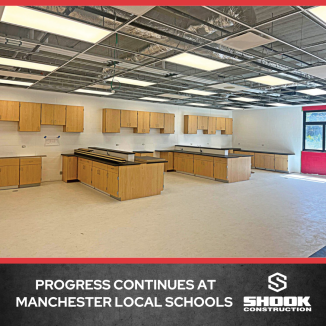 Progress Continues on Manchester Local Schools' Building Projects
May 30, 2024News
Progress Continues on Manchester Local Schools' Building Projects
May 30, 2024News
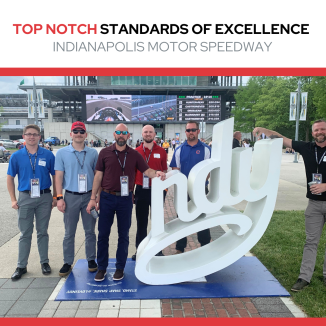 Top Notch Standards of Excellence Event
May 24, 2024News
Top Notch Standards of Excellence Event
May 24, 2024News
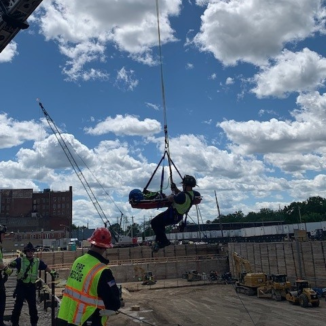 Shook Conducts Safety Trainings Across Various Projects
May 22, 2024News
Shook Conducts Safety Trainings Across Various Projects
May 22, 2024News
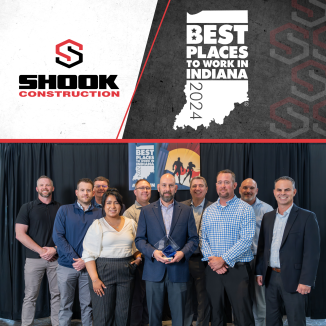 Shook is a 2024 Best Place to Work in Indiana!
May 17, 2024Awards
Shook is a 2024 Best Place to Work in Indiana!
May 17, 2024Awards
 Making 250 Tie Blankets for Children in Foster Care
May 16, 2024Mission
Making 250 Tie Blankets for Children in Foster Care
May 16, 2024Mission
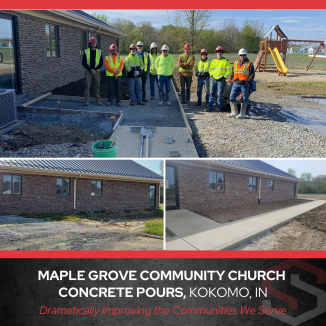 Pouring Concrete for Maple Grove Community Church
May 14, 2024Mission
Pouring Concrete for Maple Grove Community Church
May 14, 2024Mission
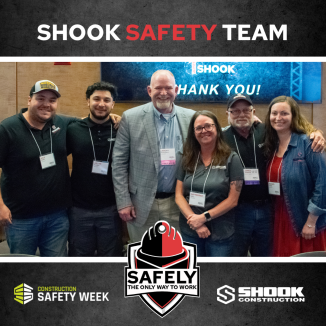 Thanking our Safety Professionals this Construction Safety Week
May 7, 2024News
Thanking our Safety Professionals this Construction Safety Week
May 7, 2024News